IoT hardware/software integration | DG Technologies
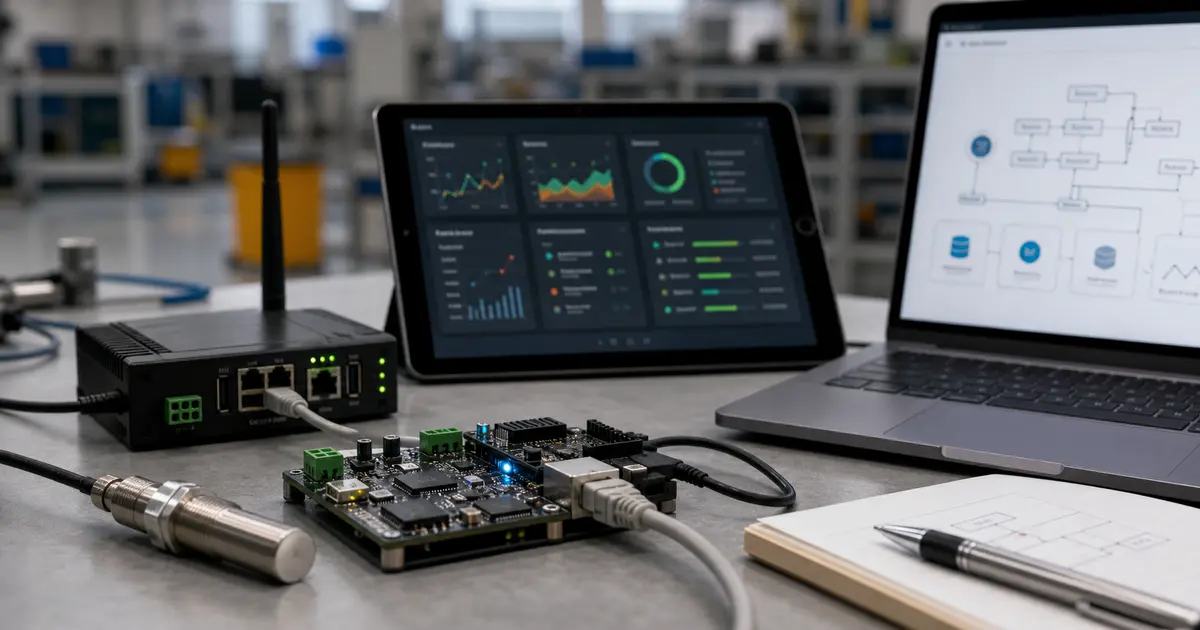
The differentiator is not the device itself. It is the quality of the bridge between field signals, data, operational logic, and the decision surface.
- Related area
- IoT and hardware/software integration
- Decision context
- H/S Dev
- Access control, badge events, NFC, or QR connected to internal workflows.
- Asset tracking and visibility on status, check-in, location, or maintenance.
- Machine data capture and operational alerting in industrial processes.
An IoT project is not valuable because it collects signals. It becomes useful when those signals turn into decisions, alerts, operational control, or visibility over a process that used to be opaque.
Many projects fail because they stop at the hardware layer or at simple dashboards. The missing part is the bridge: normalization, logic, rules, ownership, and integration with real business workflows.
When H/S Dev makes sense
- Access control, badge events, NFC, or QR connected to internal workflows.
- Asset tracking and visibility on status, check-in, location, or maintenance.
- Machine data capture and operational alerting in industrial processes.
- Hybrid systems where field, cloud, and operators must remain coordinated.
The critical point
The difficult part is not reading a signal. It is deciding how that signal becomes a useful surface for the person who must act. Without that step, the system remains a technical demo.
That is why the strongest integrations start from operations, not from the device. First you define the action, then you design the technical flow.
The short answer
The core point is not to adopt hardware/software integrations because it is technically possible, but to verify whether it improves a real operational step: fewer manual actions, fewer errors, better visibility, and faster decisions.
To evaluate "IoT and hardware/software integration: when they truly make sense", start from the workflow, available data, internal responsibilities, and the measurable impact on daily work.
How to read this topic inside a company
A page about hardware/software integrations is useful only if it helps a team decide what to do in a real case, not if it remains a generic overview. The first analysis should separate what is urgent from what is merely desirable.
Hidden cost usually appears in small operational steps: copied data, approvals handled by email, manual reports, or exceptions managed by a single person. When those steps become normal, software should make the workflow clearer before making it more automated.
A safer approach is to design a narrow first release, so the team can validate whether the solution fits daily work. Only after that does it make sense to extend features, automation, and integrations.
What the integration layer must clarify
A reliable hardware/software project needs more than sensors and connectivity. It needs a clear data path: where the signal is captured, how it is validated, how often it is sent, where it is stored, and which system becomes responsible for the operational decision.
For example, an access event, a machine alarm, or a QR scan may look simple at the device level. In practice, the system must know which user, asset, order, location, or process step the event belongs to. Without that context, the data is technically available but operationally weak.
A useful first release should define
- One operational event that matters enough to track reliably.
- The device, gateway, or app responsible for capturing the event.
- The business object connected to the signal: asset, user, order, batch, location, or ticket.
- The rule that turns raw data into an alert, status change, report, or workflow action.
- The person or team responsible for acting when the system shows an exception.
Frequently asked questions
When should a company discuss this with a technical partner?
When the issue already affects daily work, involves multiple people or tools, and creates delays, errors, or lack of control. A technical discovery clarifies whether development, integration, or process redesign is the right path.
What is the risk of starting development immediately?
The risk is building around a workflow that is not clear enough. Before writing code, the team should validate data, responsibilities, constraints, priorities, and expected outcomes.
How do you measure whether the project creates value?
Use practical metrics: less time spent on manual work, fewer errors, stronger traceability, faster response cycles, and better information quality.
Operational scenario to verify
A practical way to evaluate this decision is to observe a normal week of work: how often the team repeats the same check, how much information is copied, and which steps depend on personal memory or scattered messages.
If the problem appears only occasionally, a clearer procedure may be enough. If it slows delivery, quoting, support, or data control, then it is worth designing a more stable workflow with visible responsibilities and always updated information.
The right decision does not start from a feature list. It starts from one concrete priority: which part of the process should become simpler, more traceable, and measurable over the next thirty or sixty days.