Production traceability software and hardware signals
Production traceability works when machine data, batches, quality checks, and operators become useful signals for decisions, not just records stored after the fact.
- Related area
- IoT and hardware/software integration
- Decision context
- Production traceability
- Batch history can be reconstructed without manual detective work.
- Quality checks are tied to order, machine, operator, and timestamp.
- Collected data supports a real decision or compliance need.
production traceability hardware software should not start from a feature list. It should start from a measurable operational problem. Traceability projects often start from the technology: sensors, tablets, dashboards, barcode readers. The better starting point is operational: which event must be reconstructed, which decision must be faster, and which risk must be reduced.
The right decision is not always to build from scratch. Sometimes a custom product is needed; in other cases the smarter move is to integrate existing systems, fix the data flow, and make responsibilities and statuses visible.
When custom development makes sense
Custom development makes sense when production rules, machine signals, quality checks, batches, and operator actions need to be joined into a workflow that standard tools cannot represent clearly.
The practical criterion is simple: if the advantage comes from how the business operates, software must fit the workflow. If the process is standard, custom development may add cost without adding strategic value.
When integration is the better route
Integration is the better route when ERP, MES, or machine systems already hold part of the truth but do not communicate well. The goal is to connect events without forcing people to enter the same data twice.
Integration does not mean settling for less. It means keeping the parts that already work and building the missing connection: consistent data, fewer manual steps, and one readable view of the workflow.
Checks before deciding
- Batch history can be reconstructed without manual detective work.
- Quality checks are tied to order, machine, operator, and timestamp.
- Collected data supports a real decision or compliance need.
- Exceptions create visible actions for the right role.
Data, integrations, and ownership
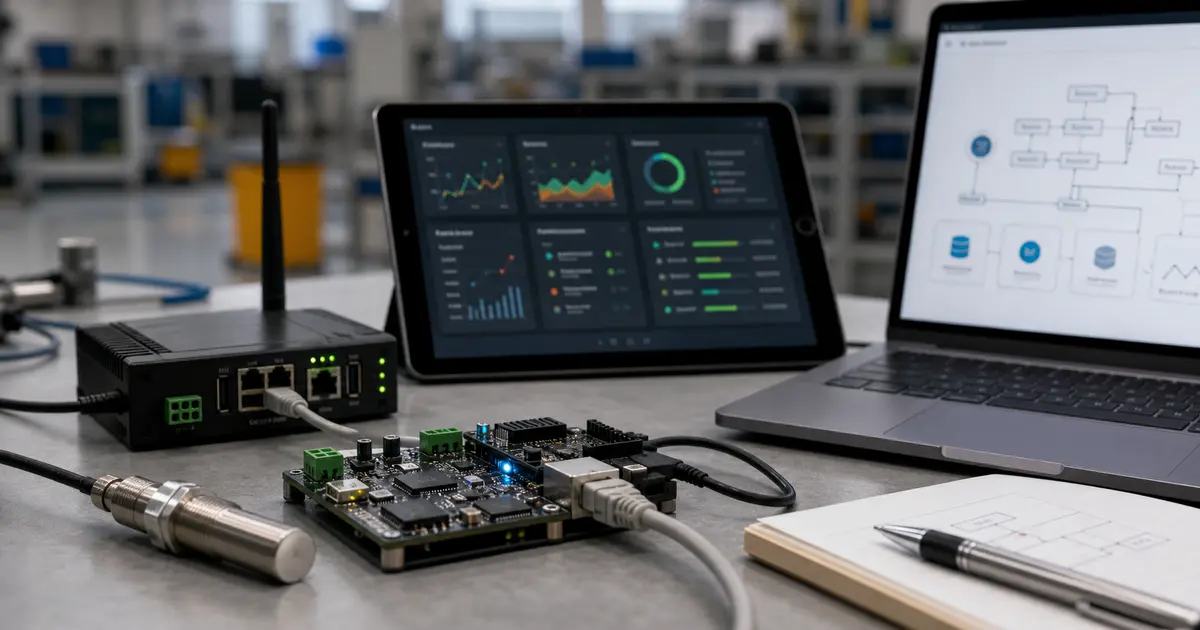
Typical integrations include ERP, MES, PLCs, sensors, barcode readers, shop-floor tablets, quality systems, and reporting dashboards. The design choice is deciding which signals should be automatic and which require human confirmation.
A solid project also clarifies who owns the data, who can change it, which events must be tracked, and which reports prove whether the system is improving the work.
Mistakes to avoid
- Collecting every available signal instead of the signals that change decisions.
- Leaving operators with extra input work and no operational benefit.
- Treating reporting as the goal instead of using data to reduce risk and response time.
How to shape the first release
A first release should track a small number of critical events, connect them to batch and order, and make exception review faster than the current manual process.
The first version should create trust: few steps, clear ownership, verifiable data, and one simple metric to show whether manual work is actually decreasing.
Recommended first step
Start with one production line, product family, or traceability risk. Map the events that matter and remove every data point that does not support a decision.
At DG Technologies, this analysis becomes the basis for scope, integrations, risks, and a sustainable first release. The goal is to build the smallest useful surface that can still change daily work.
FAQ
Do traceability projects always need new hardware?
No. Some projects can use existing machine data or operator input. New hardware is useful only when it captures a signal that would otherwise be unreliable.
What is the most important traceability data?
The data that helps reconstruct a batch, identify responsibility, or act faster during an exception.
Can traceability slow down operators?
It can if the workflow asks for unnecessary input. Good traceability reduces ambiguity without adding friction.